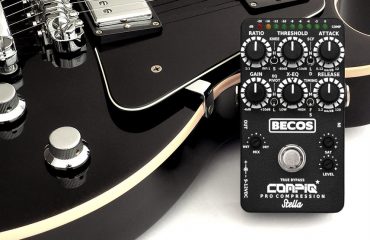
 CompIQ STELLA
 CompIQ YUNA
 CompIQ TWAIN
 CompIQ MINI
 CompIQ ONE
 Ziffer Overdrive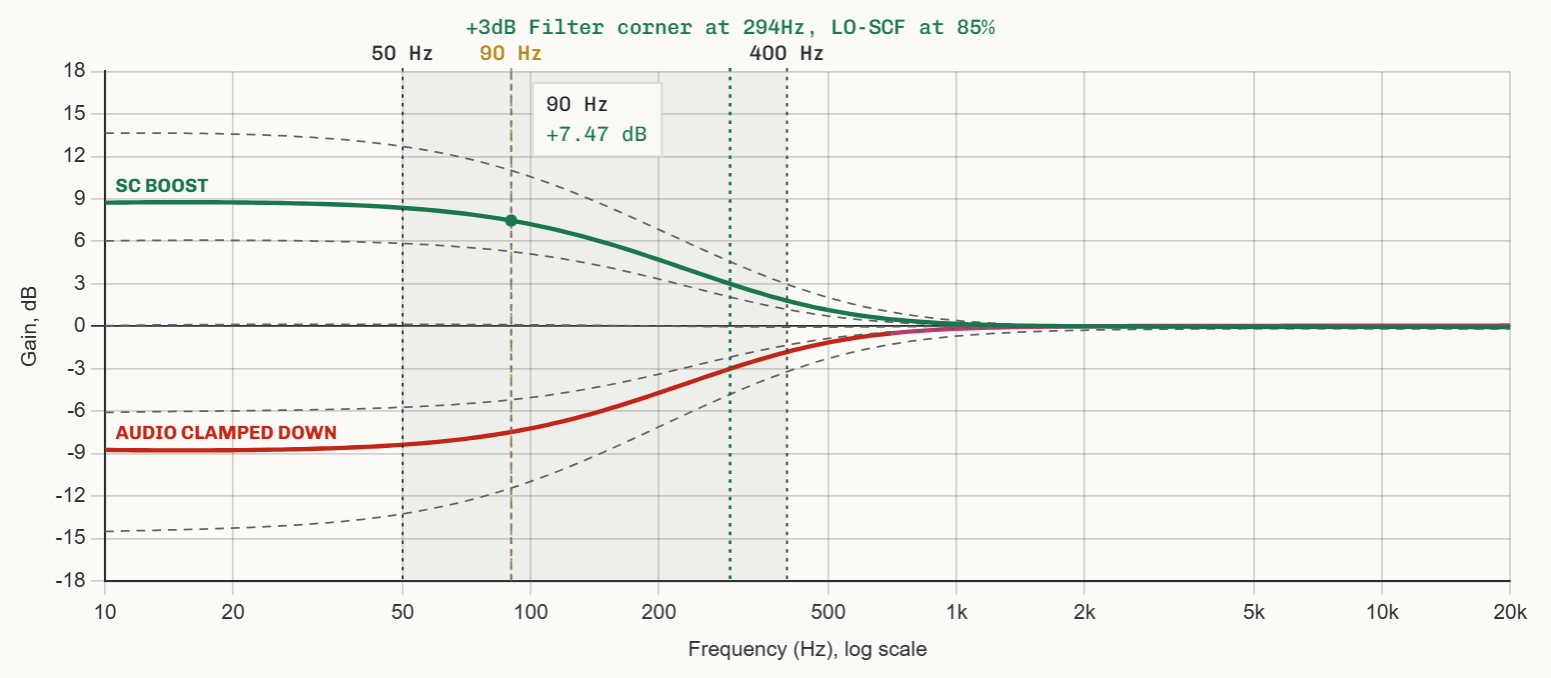
BECOS FX Compressors Lows Side-Chain Filter Interactive Plot
How the compressor Side-Chain Filter really works? The filter plots below are the most honest way to show what the LO-SCF does. Marketing wording like “cuts from 50 Hz to 400 Hz” or “centred at 90 Hz” suggests a hard band. The real filter is a smooth curve: it cuts or boosts a little at 400 Hz, more at 200 Hz, and most at the bottom of the range. Moving the slider shows that curve getting deeper or shallower, and moving the 3 dB corner up or down.
That curve acts on every note you play, through the compressor’s detector. Before deciding whether to compress, the detector hears each note at its amplitude level plus the filter’s cut or boost at that note’s frequency. On a 5-string bass the low B is at 31 Hz, E at 41 Hz, A at 55 Hz, D at 73 Hz and G at 98 Hz. So with the same setting, each string gets a different amount of cut or boost in the sidechain. The low B is affected most, and notes higher up the neck less and less.
This works like a threshold that changes with frequency:
- CUT raises the threshold for the low notes. A low note now has to be louder before it triggers compression. If the cut is deep enough, it no longer reaches the threshold at all. It then passes through without being compressed, and the make-up gain, which stays the same, lifts it along with everything else. Compared with the notes that are being compressed, it sounds bigger and more open. That’s what “freed up” means.
- BOOST lowers the threshold for the low notes. Even quiet low notes or a thin-sounding instrument start triggering compression earlier and harder, so the low end is held tight and even.
One thing doesn’t change: once the compressor is triggered, it turns down the whole signal, all frequencies at once. The filter doesn’t change what gets compressed. It changes which notes trigger the compression, and how easily. With the filter engaged, the compressor’s trigger depends on frequency.
The interactive slider directly replicates the behavior of our SCF knob, allowing you to boost or cut frequencies in the compressor’s side-chain. It rests in a neutral position at the center. Use the make-up gain control to observe how perceived loudness influences how we match compressor output by ear. We corelated this model with sampled spectra from real-world bass and guitar audio clips. Switch between these profiles to see exactly how the filter shapes the threshold and overall compression.