

 CompIQ STELLA
 CompIQ MINI
 CompIQ TWAIN
 CompIQ YUNA
 CompIQ ONE
 Ziffer Overdrive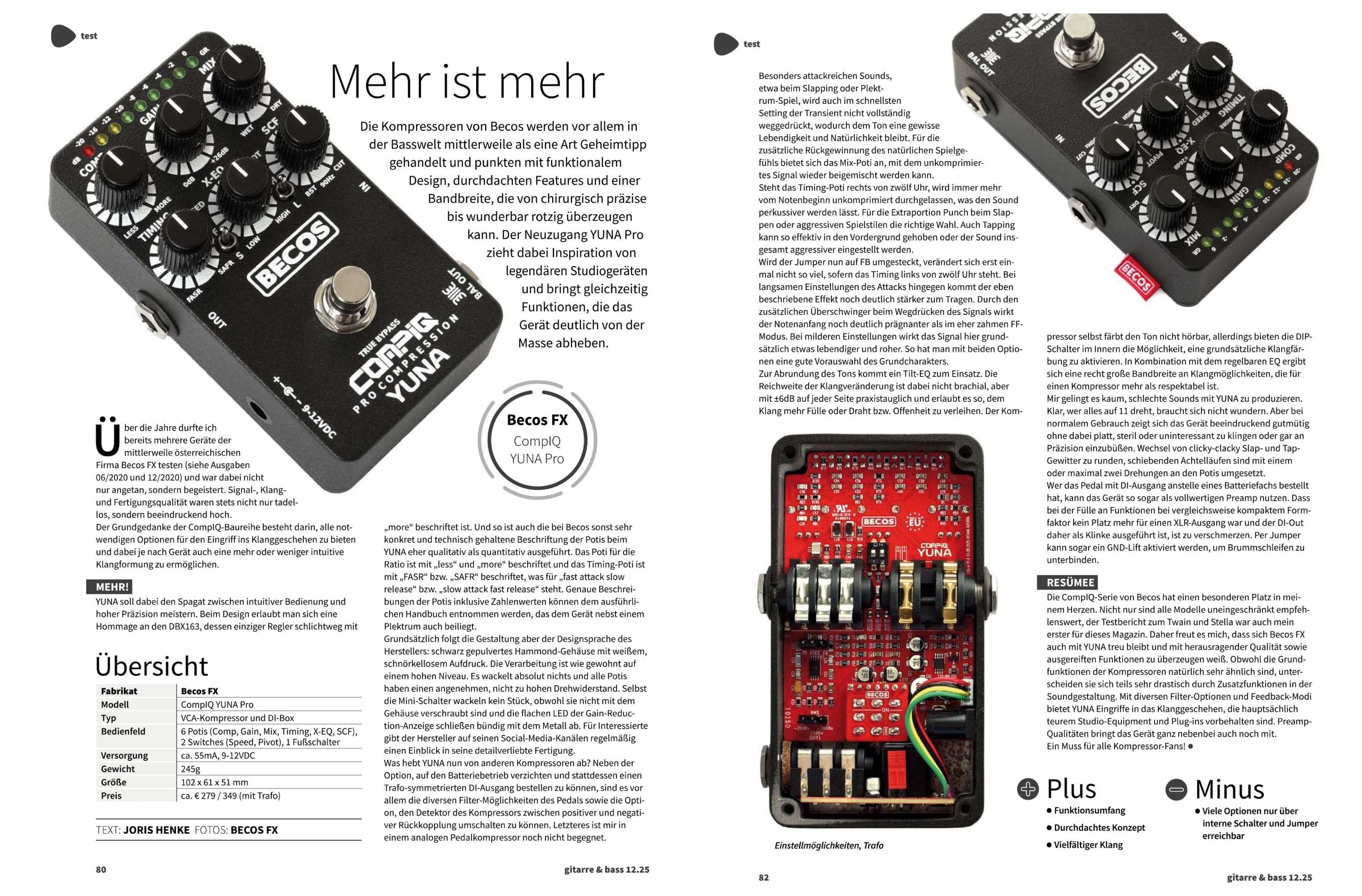
BECOS FX CompIQ YUNA Pro Compressor reviewd by Gitarre und Bass Magazine
We are so honored to have our new CompIQ Yuna Pro Compressor Pedal for Bass and Guitar reviewed by the prestigious Gitarre und Bass Magazine in the December 2025 (German Language) printed edition, in not one but three pages! The magazine calls the YUNA Pro “A must-have for all compressor fans!” It’s clear that our blend of studio-grade features and high-quality build has made a good impression, and we can’t be happier!
A heartfelt thank you to the team at Gitarre und Bass and the author of the review, Mr. Joris Henke, for putting our product through its paces in such serious and detailed testing. We are thrilled with the results and the kind words.
For all our fans who don’t read German, you can now read the complete, translated English review right here. You can also read the review in the paper magazine accessible below.
Read the German Language review: PDF
TEST – BECOS FX COMPIQ YUNA PRO
More is more
Compressors from Becos are now considered a kind of insider tip in the bass world. They score points with functional design, well-thought-out features, and a range that can impress from surgically precise to wonderfully gritty. The newcomer, the YUNA Pro, draws inspiration from legendary studio equipment while also bringing features that clearly set the device apart from the masses.
Over the years, I’ve had the pleasure of testing several devices from the now Austrian company Becos FX (see issues 06/2020 and 12/2020) and was not just pleased, but enthusiastic. Signal, sound, and manufacturing quality have always been not only flawless but impressively high. The basic idea of the CompIQ series is to offer all necessary options for intervening in the sound while also enabling a more or less intuitive sound shaping, depending on the device. The YUNA aims to master the balancing act between intuitive operation and high precision.
The design is a homage to the DBX163, whose only control is simply labeled “more”. Accordingly, the labeling of the pots on the YUNA, which is otherwise very specific and technical at Becos, is more qualitative than quantitative. The pot for the Ratio is labeled “less” and “more”. The Timing pot is labeled “FASR” and “SAFR,” which stands for “fast attack slow release” and “slow attack fast release” respectively. Exact descriptions of the pots, including numerical values, can be found in the comprehensive manual that comes with the device along with a pick.
Fundamentally, the design follows the manufacturer’s language: black powder-coated Hammond enclosure with white, simple printing. As usual, the workmanship is on a high level. Absolutely nothing wobbles, and all pots have a pleasant, not too high rotational resistance. Even the mini-switches don’t wobble at all, although they aren’t screwed to the housing, and the flat LEDs of the Gain Reduction display are flush with the metal. For those interested, the manufacturer regularly provides insight into its detail-oriented production on its social media channels.
What sets the YUNA apart from other compressors? In addition to the option of forgoing battery operation and ordering a transformer-balanced DI output instead, it’s primarily the pedal’s various filter options and the ability to switch the compressor’s detector between positive and negative feedback. The latter is something I haven’t encountered in an analog pedal compressor before.
Under the hood
Since quite a few unusual functions are housed under one roof here, I’d like to introduce them so that the manual doesn’t become a reference book while reading this report.
- Compression: This is simply the Ratio of the compressor, i.e., how strongly the signal is “flattened”.
- Gain: Makeup Gain for setting the output volume; this pot has no influence on the compression.
- Mix: Pot for setting the wet/dry blend ratio.
- Timing: This is where it gets interesting. Instead of separate Attack and Release pots, both parameters are housed in one pot and are adjusted in opposite directions. A short Attack thus results in a slow Release and vice versa. This is a sensible assignment for most pedal compressor applications. The “Speed” switch allows switching between sluggish and fast behavior.
- X-EQ: This is a Tilt-EQ. Depending on the position of the “EQ-Pivot” switch, it either boosts everything above the frequency (300 or 1000 Hz) and cuts everything below it, or vice versa, depending on the direction of rotation.
- SCF: Setting for the Sidechain Filter. The sidechain is the detector circuit in the compressor. It is common practice to cut bass frequencies in the detector signal so that the compressor doesn’t react to every small movement in the deep lows. With YUNA, however, the detector can be adjusted to be not only less sensitive but also more sensitive using the Boost function, allowing for creative use. Importantly, this filter has no direct influence on the sound and should not be confused with multiband compression.
Internal settings
Inside the pedal, two jumpers and DIP switches allow for further customization options:
- Voicing: The DIP switches can apply a fixed EQ to the signal if needed. Options include a neutral setting, a treble boost, a midrange cut, and a combination of both.
- RMS: This jumper sets the basic sensitivity for the detector. -30dBu is intended for instruments with very low output, while the -10dBu setting is suitable for high-output instruments or studio equipment. The factory setting is -20dBu.
- FEED: The upper jumper allows switching between positive (FF) and negative (FB) feedback in the detector.
– In FF-Mode (Feed-Forward), the compressor works very precisely.
– In FB-Mode (Feed-Back), depending on the setting, more “character” is added, and the operation becomes grittier and more intense. With slow Attack, this setting causes the compressor to temporarily push the signal even below the threshold, providing a particularly strong emphasis on the start of the note. The graphic shows this clearly. After the level rises sharply, the compressor engages and reduces the signal to the threshold. In FF-Mode, this process is precise and accurate. In FB-Mode, overshoots are visible, where the signal is briefly compressed too strongly – this is the dip in the graphic.
Two faces
The switching of the FF- or FB-Mode, in particular, has strong effects on the sound and playing feel. In FF-Mode, compression is precise and, thanks to the Soft-Knee, very musical. In the fastest setting, the YUNA can also be used as a limiter, although the pedal is not suitable as a hard “brickwall” limiter. With moderate settings of the Compression pot, rather fast settings can be used to catch peaks and musically homogenize the sound.
Conclusion
Even with particularly attack-rich sounds, such as slapping or pick playing, the transient isn’t completely suppressed even in the fastest setting, which maintains a certain liveliness and naturalness in the tone. For additional recovery of the natural playing feel, the Mix pot is useful, allowing uncompressed signal to be blended back in.
If the Timing pot is set to the right of twelve o’clock, more and more of the note’s start is allowed through uncompressed, making the sound more percussive. This is the right choice for an extra portion of punch when slapping or using aggressive playing styles. Tapping can also be effectively brought to the foreground, or the overall sound can be set more aggressively.
If the jumper is switched to FB, not much changes initially, provided the Timing is set to the left of twelve o’clock. However, with slow Attack settings, the effect just described is even more pronounced. Due to the additional overshoot when the signal is compressed, the note’s start appears even more distinct than in the rather tame FF-Mode. With milder settings, the signal here generally feels more lively and raw. Thus, both options offer a good preliminary choice of the basic character.
A Tilt-EQ is used to round out the tone. The range of sound change is not brutal, but with plus/minus 6dB on each side, it’s practical. It allows you to give the sound more fullness, crispness, or openness. The compressor itself does not audibly color the tone, but the internal DIP switches offer the option to activate a fundamental sound coloring. In combination with the adjustable EQ, a quite large bandwidth of tonal possibilities results, which is more than respectable for a compressor.
It’s hard for me to produce bad sounds with the YUNA. Sure, if you turn everything up to 11, don’t be surprised. But with normal use, the device proves to be impressively forgiving without sounding flat, sterile, or uninteresting, or sacrificing precision. Switching from clicky-clacky slap and tap assaults to round, driving eighth-note lines is implemented with one, or at most two, turns of the pots.
If you ordered the pedal with a DI output instead of a battery compartment, you can even use the device as a fully-fledged preamp. It’s acceptable that, given the abundance of functions in a comparatively compact form factor, there wasn’t room for an XLR output, and the DI Out is therefore implemented as a jack. A jumper can even activate a GND lift to suppress hum loops.
Summary
The CompIQ series from Becos holds a special place in my heart. Not only are all models unreservedly recommendable, but the review of the Twain and Stella was also my first for this magazine. Therefore, I am pleased that Becos FX remains true to itself with the YUNA and impresses with outstanding quality and sophisticated features. Although the basic functions of compressors are naturally very similar, they differ quite drastically in sound shaping due to additional features. With various filter options and feedback modes, the YUNA offers sound interventions that are mainly reserved for expensive studio equipment and plugins. Preamp qualities bring the device along on the side. A must-have for all compressor fans!
Plus
- Functional range
- Well-thought-out concept
- Diverse sound
Minus
- Many options only accessible via internal switches and jumpers


